Astrology
The moment your child took their first breath, the sky drew a pattern that will never repeat. A baby birth chart turns that exact instant into a gentle portrait of who this little person is beginning to be. Not a destiny, not a label, just a tender map of temperament, needs and gifts that parents can actually use.
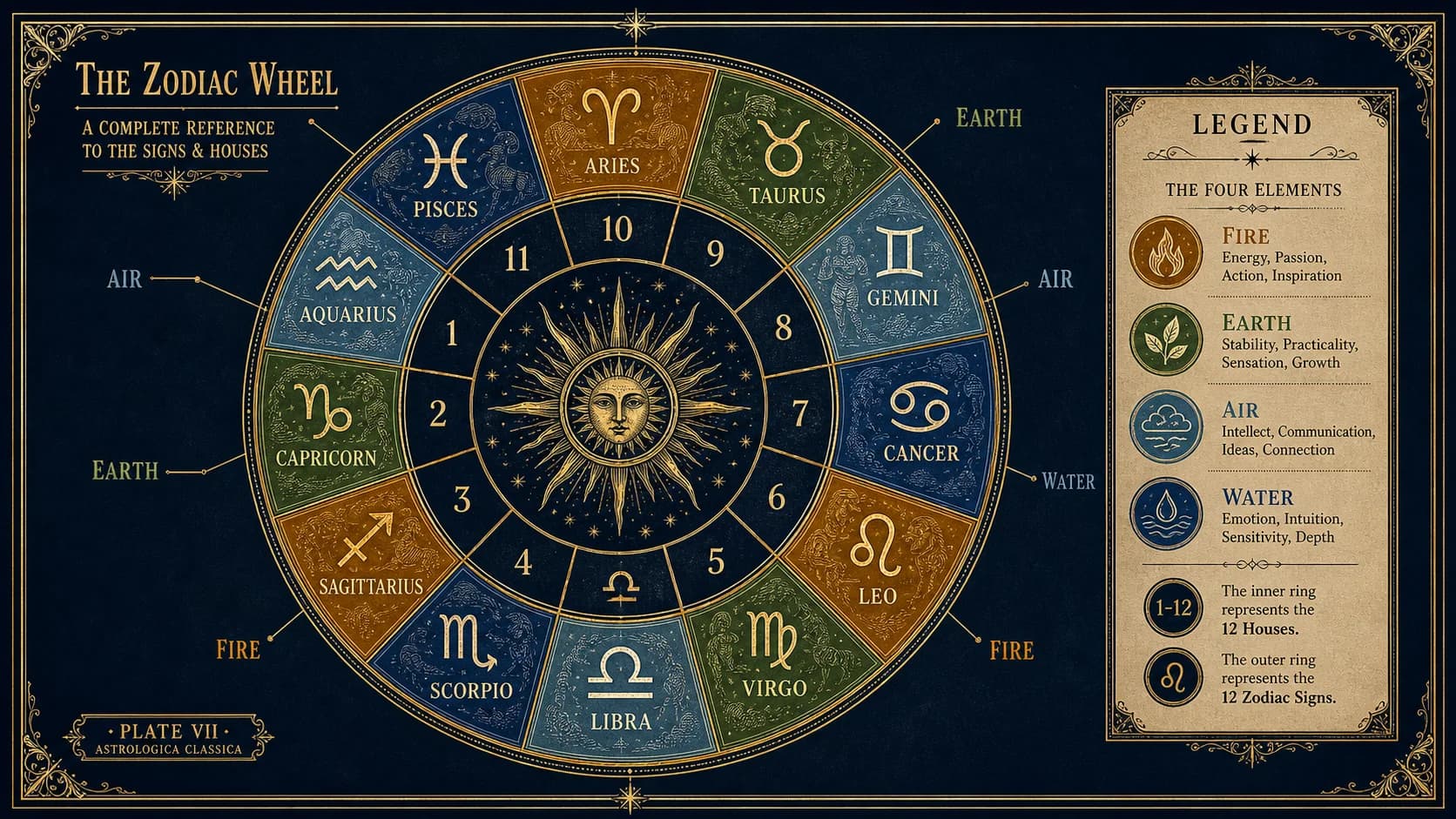
A baby birth chart is the natal chart of a newborn: a snapshot of the sky at the exact place and minute of their birth. Read for a baby, it is not about career, love or the year ahead. It is about temperament, emotional needs and the first gifts a child arrives with.
This guide explains what a newborn's chart contains, how to read its three most useful pieces, and how parents can turn it into something warm and practical rather than a set of predictions.
Two things make a newborn's chart special.
First, the birth time is exact. With adults we constantly fight missing or approximate birth times, which blurs the Ascendant and the Moon. Parents almost always have the precise minute, so a baby's chart can be read with a precision we rarely get otherwise.
Second, the questions change. Nobody reads a two week old chart for a career path. What matters is gentler and more immediate: how does this baby seek comfort, what overwhelms them, what lights them up, what rhythm suits them. A baby chart is a portrait of tendencies, read with tenderness, never a fixed script.
To read a newborn's chart you need three precise details:
With these, you can calculate the chart for free on any astrology tool, or get a personalized birth chart for your baby that computes and interprets it for you, written for parents rather than for an adult reading their own chart.
An adult chart has ten planets and twelve houses. For a newborn, start with the same three pillars that anchor any chart, but read them through the lens of a parent.
The Sun is the seed of who your child is becoming, their basic vitality and the quality they will grow into. In a baby, it reads less like a personality and more like a flavour: a sunny Leo warmth, a curious Gemini spark, a steady Taurus calm. It is the note the whole chart is tuned to.
For a newborn, the Moon is the single most useful placement. It describes emotional needs and, above all, what brings comfort. A Cancer Moon baby may settle with closeness and holding. An Aquarius Moon baby may need a little space and novelty. A Taurus Moon often craves routine, warmth and physical softness. When a baby cannot yet tell you what they need, the Moon is a gentle first hypothesis.
The Ascendant is the mask that faces outward, the instinctive first reaction to any new situation. It is why the birth time matters so much: without it, there is no Ascendant. In a baby it shows up as a first impression, the way they greet a room, a bath, a stranger. A fiery Ascendant meets the world head on, a watery one feels it out first.
Read honestly, a newborn's chart is a map of tendencies, not certainties. It can suggest that a child may be sensitive to noise, may love routine, may be quick to react or slow to warm. It cannot tell you who they will marry, what they will do for a living, or whether they will be happy. Those pages are theirs to write.
The healthiest way to hold it is as a portrait of possibilities. Children constantly surprise the charts drawn for them, and that is exactly as it should be.
The point is not to predict. It is to look at your child with curiosity. A baby chart gives you small, concrete starting points:
Many parents keep the printed chart as a keepsake, framed in the nursery, revisited on birthdays as the child grows into or away from it.
If you want the calculated and interpreted version, our Baby Birth Chart turns the exact date, time and place of birth into a tender report and a printable keepsake, written for the people who love this child. It is also designed to be offered, which is why it is often chosen as a birth gift by a grandparent, a godparent or a close friend.
A birth chart is not a written destiny. It is the first page of a story that has only just begun.
Isn't it too early to know a newborn's personality?
A birth chart never claims to know a personality in full. It sketches tendencies, a natural temperament and emotional needs. Reading it early is precisely the point, it gives parents a gentle frame to understand how their baby meets the world, long before words arrive. Think of it as a portrait of possibilities, not a verdict.
Do I really need the exact birth time?
For a baby, yes, and that is the good news. Parents almost always have the exact minute written on the birth record, which removes the biggest source of error we face with adult charts. The birth time is what lets us place the Moon precisely and calculate the Ascendant, the two most useful pieces for understanding a newborn.
What can a baby chart actually tell me as a parent?
The most practical readings are the Moon and the Ascendant. The Moon points at how your baby seeks comfort and what soothes them. The Ascendant describes their first instinctive way of reacting to the world. Together they offer small, concrete clues about rhythm, sensitivity and what a particular child may find reassuring.
Is a birth chart a good gift for new parents?
It is one of the rare gifts that is both personal and lasting. The baby is the subject, the parents are the keepers, and the printed chart becomes a keepsake for the nursery wall. Because the giver is usually not the parent, it also carries a warmth that a self bought object rarely has.
Is astrology scientific?
No, not in the academic sense, and we will always be honest about that. Astrology is a symbolic language, like a myth or a tarot spread. It gives you a coherent, ancient frame to look at your child with curiosity and tenderness. Approach it as a keepsake and a conversation starter, not as a medical or developmental tool.
Take the next step
The stars at birth
Gift this chart