Tarot
Tarot is a mirror, not a crystal ball. You ask a question, you draw three cards, and what shows up is not a future carved in stone. It is a reflection of what is already at play inside you, around you, and inside the situation you carry. The beauty of the 3-card spread is that it is simple enough for a beginner to try tonight, and deep enough that a seasoned practitioner returns to it for a lifetime.
This guide gives you everything you need to interpret your first spread without a guru and without fear. The anatomy of the Rider-Waite-Smith deck, the exact ritual for a 3-card reading, how to phrase a question that makes the answer useful, the 10 Major Arcana you will draw most often, and what to do when a card lands reversed.
An honest disclaimer before we start. Tarot is not an exact science. It does not tell you whether your ex will come back or whether you will get promoted. It opens angles and surfaces information you already know but have not admitted to yourself. Approach it as a dialogue with yourself, not as a GPS.
The Rider-Waite-Smith deck (created in 1909 by Arthur Edward Waite and illustrated by Pamela Colman Smith) is the world reference deck. If you are a beginner, this is the one you want. Its illustrations are rich in symbols, intuitively readable, and most tarot books and guides rely on it.
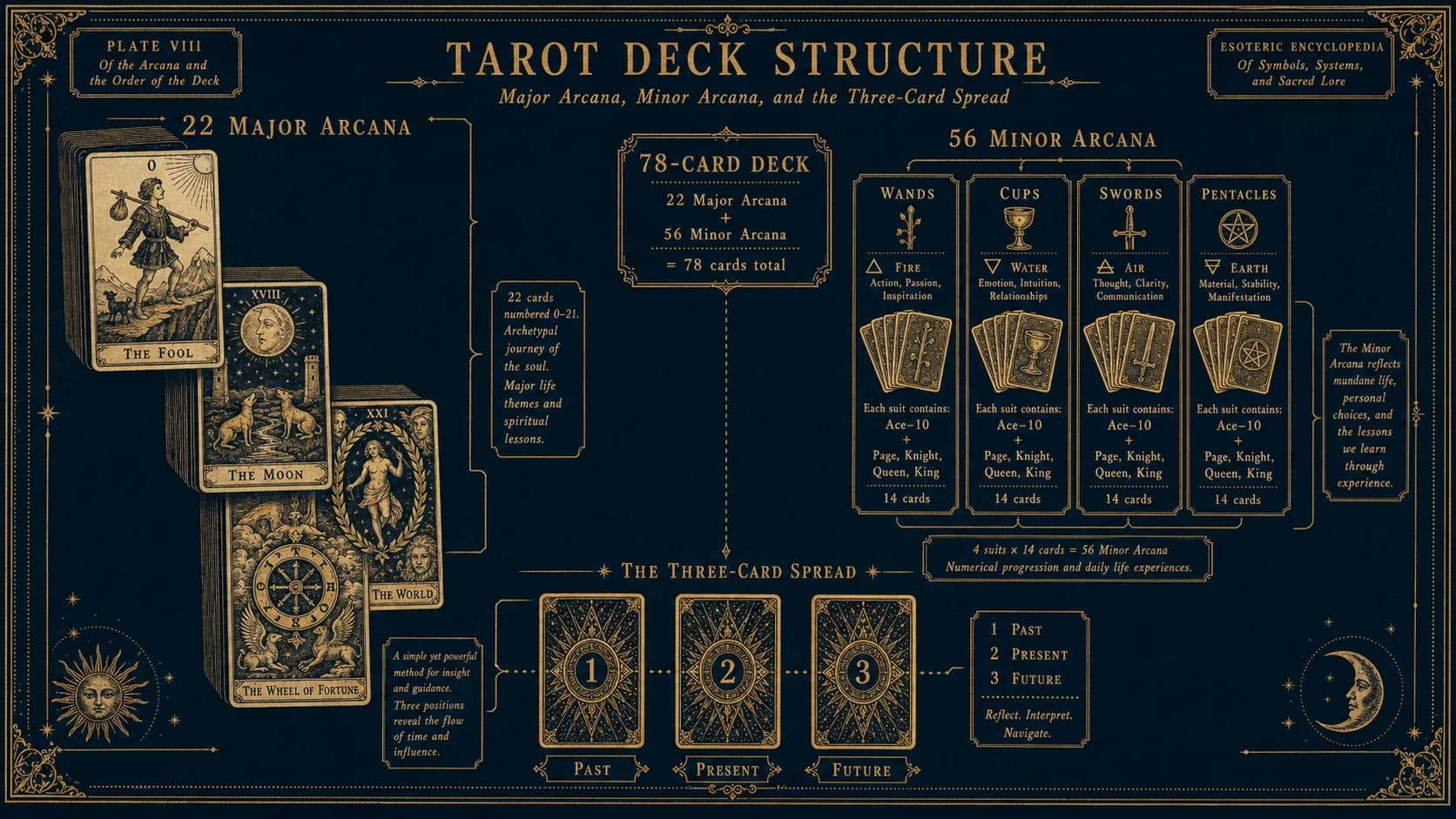
A full deck contains 78 cards, split into two families.
From The Fool (0) to The World (XXI). These are the most symbolically loaded cards in the deck. They represent the major forces and archetypes of life: birth, love, transformation, power, death, illumination. When a Major Arcana shows up in your spread, the energy it carries is rarely trivial. It is often a structural theme for the moment you are going through.
The journey of the Major Arcana is sometimes called the Fool's journey: from the innocent who sets out with nothing (0) to the realized sage who has integrated everything (XXI). It is an initiatory path.
Four suits, mapped to the four elements.
Wands (Fire) speak of action, ambition, creative energy, and passion. If many Wands turn up in your spread, the moment calls for action and movement.
Cups (Water) speak of emotions, love, intuition, and relationships. A spread saturated with Cups means the subject is emotional, sentimental, and deep.
Swords (Air) speak of thought, conflict, truth, and words. Many Swords mean a mental period, decision-making, or intellectual tension.
Pentacles (Earth) speak of matter, money, the body, work, and stability. Many Pentacles mean you are in the concrete, the material, the foundations.
Each suit runs from the Ace to the 10, then includes four court cards: Page (apprentice, message), Knight (action, movement), Queen (inner mastery), King (outer mastery).
The 3-card spread is the best entry point into tarot. It is simple enough that you will not get lost, and rich enough to deliver a real reading. Here is the step-by-step ritual.
Step 1. Ask your question (we will come back to this in detail in the next section). Without a clear question, the spread becomes blurry.
Step 2. Shuffle the deck slowly, holding your question in mind. No need for a complex method. Three minutes of shuffling, letting your mind drift naturally back to what you are looking for.
Step 3. Cut the deck into two or three piles with your non-dominant hand (the one that connects you to intuition). Put it back together in whatever order feels right.
Step 4. Draw three cards from the top of the deck and place them face down, from left to right. Not in a fan, just lined up.
Step 5. Flip them one at a time, in order. Do not flip them all at once. Each card deserves your full attention on its own, in its context.
Position 1 (the left card): the Past. What already belongs to the situation, what caused it, the energies that prepared the present moment. It is often a card that makes you say "yes, that tracks" rather than a revelation.
Position 2 (the middle card): the Present. The main energy at work right now. This is the most important card in the spread, the one around which everything else organizes itself. Give it more time than the other two.
Position 3 (the right card): the Future. Not an absolute prediction. Rather a trend or a possible direction if current energies keep unfolding as they are. If you change something in the present, this future shifts as well.
Past / Present / Future is the classic version, but you can also use:
Pick the variation based on your question before you draw, not after.
This is the step most beginners skip, and yet it is the most important one. A bad question gives a fuzzy reading. A good question makes the answer useful.
Closed yes/no questions. Tarot answers poorly to "Will I get this promotion?" because tarot does not do binary. Rephrase it: "What do I need to know about my application for this promotion?"
Questions about other people. "Will he come back?" or "Does she really love me?" run into both an ethical and a practical issue. You do not read for someone who is not in front of you, and you do not know what is going on inside their head. Refocus on yourself: "What do I need to understand about my relationship with X right now?"
Repeated questions. If you redo the same spread three times until you get the answer you want, the tarot loses all value. One question, one spread. If the answer does not please you, it probably means it is saying something uncomfortable but true.
"What do I need to understand about... ?" opens reflection rather than chasing certainty.
"How can I move forward on... ?" places you as an active subject of your life, not a passive spectator.
"What am I missing about... ?" is the most powerful question when you sense you are going in circles.
"What energy am I bringing to... ?" makes you reflect on your own part in the situation, which is almost always useful.
Here are the Major Arcana you will meet most often in your spreads, with their base meaning. Learn these first.
| Card | Number | Main energy | When it shows up |
|---|---|---|---|
| The Fool | 0 | Beginning, innocence, leap into the unknown | You are at the threshold of a new cycle |
| The Magician | I | Initiative, resources, action | You have everything you need to start |
| The Empress | III | Fertility, creativity, abundance | A fertile phase, a project taking shape |
| The Lovers | VI | Choice in love, alignment | An emotional or values-based decision |
| The Wheel of Fortune | X | Cycles, shift in luck | The wind is turning, get ready |
| Strength | XI | Quiet mastery, calm courage | You have more power than you think |
| Death | XIII | Transformation, end of a cycle | Something must die so it can be reborn |
| The Devil | XV | Attachments, dependencies | You are tied to what limits you |
| The Tower | XVI | Sudden release, revealing shock | Necessary collapse of an illusion |
| The Star | XVII | Hope, renewal, guidance | Light at the end of the tunnel |
A key note on Death (XIII). This is the most misunderstood card in the tarot. It almost never signals literal death. It speaks of transformation, of the end of a cycle that clears space for the next one. When Death turns up, ask yourself: what in me needs to die so I can actually move forward?
A note on The Tower (XVI). This is the second most feared card. It often announces a sudden break (a revelation, a resignation, a separation, a truth coming out), but that break is almost always liberating in the long run. What collapses is a structure that was no longer authentic.
When you flip a card, it can land upright or reversed (upside down). Many practitioners use reversed cards as an extra layer of interpretation.
A reversed card generally points to an energy that is blocked, internalized, still being integrated, or in excess compared with its upright meaning. The Star upright is luminous hope. The Star reversed is hope that doubts itself, or that does not allow itself to be felt.
For a beginner, the advice is to ignore reversals at first. Focus on the upright meaning of each card. You already have plenty to learn over the first few months. You can fold in reversals once your foundations are solid, usually after six months to a year of regular practice.
If you still want to use them, hold on to one simple rule. The reversed meaning is rarely the opposite of the upright meaning. It is more like a nuance, an inward turn, or a friction in the energy.
Here is the reproducible method in 5 steps for reading a 3-card spread once you have flipped your three cards.
Step 1. Look at the images before the meanings. What is your first emotional reaction to each card? Dominant colors, postures of the figures, overall atmosphere. That initial intuition is precious.
Step 2. Identify the dominant note. How many Major Arcana are in your spread? How many of each minor suit? If all three cards are Cups, your question is more emotional than you realized. If they are all Majors, you are at an important turning point.
Step 3. Read each card in its position. The Five of Swords in the Past does not read the same as the Five of Swords in the Future. Position 1 = what caused it. Position 2 = active energy. Position 3 = possible direction. Adapt the meaning to the position.
Step 4. Look for links between cards. Are the figures looking at each other? If the Knight of Wands looks toward the next card, he is pushing toward it. Do the colors echo across the spread? Do the elements clash or complement each other?
Step 5. End with the question: "What is this spread telling me in one sentence?" Force yourself to synthesize. If you cannot put it into one sentence, you have not yet integrated the reading. Go back through it.
This is the method our AI applies in our AI tarot reading. In 30 seconds, it observes your three cards, identifies the dominant note, reads each position, cross-checks the symbols, and delivers the synthesis already done. You can also train on your own deck by following exactly the same 5 steps.
Do you need a psychic gift to read tarot?
No. Tarot works as a coherent symbolic system. You learn the meaning of the 78 cards (the 22 Majors are enough at the start), you interpret them in context, and you trust your observation. Intuition develops with practice, it is not a prerequisite. The best readers are first and foremost good observers, attentive to nuance and to connections.
How many times a day can I read the tarot?
Once per question, and ideally no more than one spread per day. If you redo the same spread because you do not like the answer, you disqualify the tool. One reading per day, on a question that genuinely deserves to be asked, is plenty. Tarot is powerful when it is respected, not when it is spammed.
Can you read tarot on someone without their consent?
Technically, yes. Ethically, many practitioners say no. The reason is that tarot reveals intimate things, and reading for someone without their explicit consent means entering their energetic space without permission. Read about your relationship with that person, not about the person themselves.
Which tarot deck should I buy to get started?
The Rider-Waite-Smith, without hesitation. It is the global standard, the most illustrated, the most documented. Expect to pay 20 to 30 euros for a quality copy. Once you have mastered this one (count on 6 to 12 months of practice), you can explore more artistic decks (Tarot de Marseille, Wild Unknown, Light Seer's Tarot, and others) already knowing how to read the symbols.
Does tarot actually work?
The answer depends on what you expect. If you are looking for a literal prediction of the future, tarot does not work. If you are looking for a mirror that surfaces information you already carry without admitting it, that confronts you with angles you avoid, that pushes you to articulate what you feel, then yes, it works remarkably well. It is a tool for inner dialogue, not a crystal ball.
Take the next step
Cards don't predict, they reveal
Draw My Cards