Palmistry
Your palm is a map nobody else carries. The lines you see there were drawn by your genetics, sculpted by your experiences, and they keep evolving every year. Palmistry is the art of reading this map. Not to predict your future in a literal sense, but to understand your natural tendencies, your strengths, your blocks and the chapters taking shape in your life.
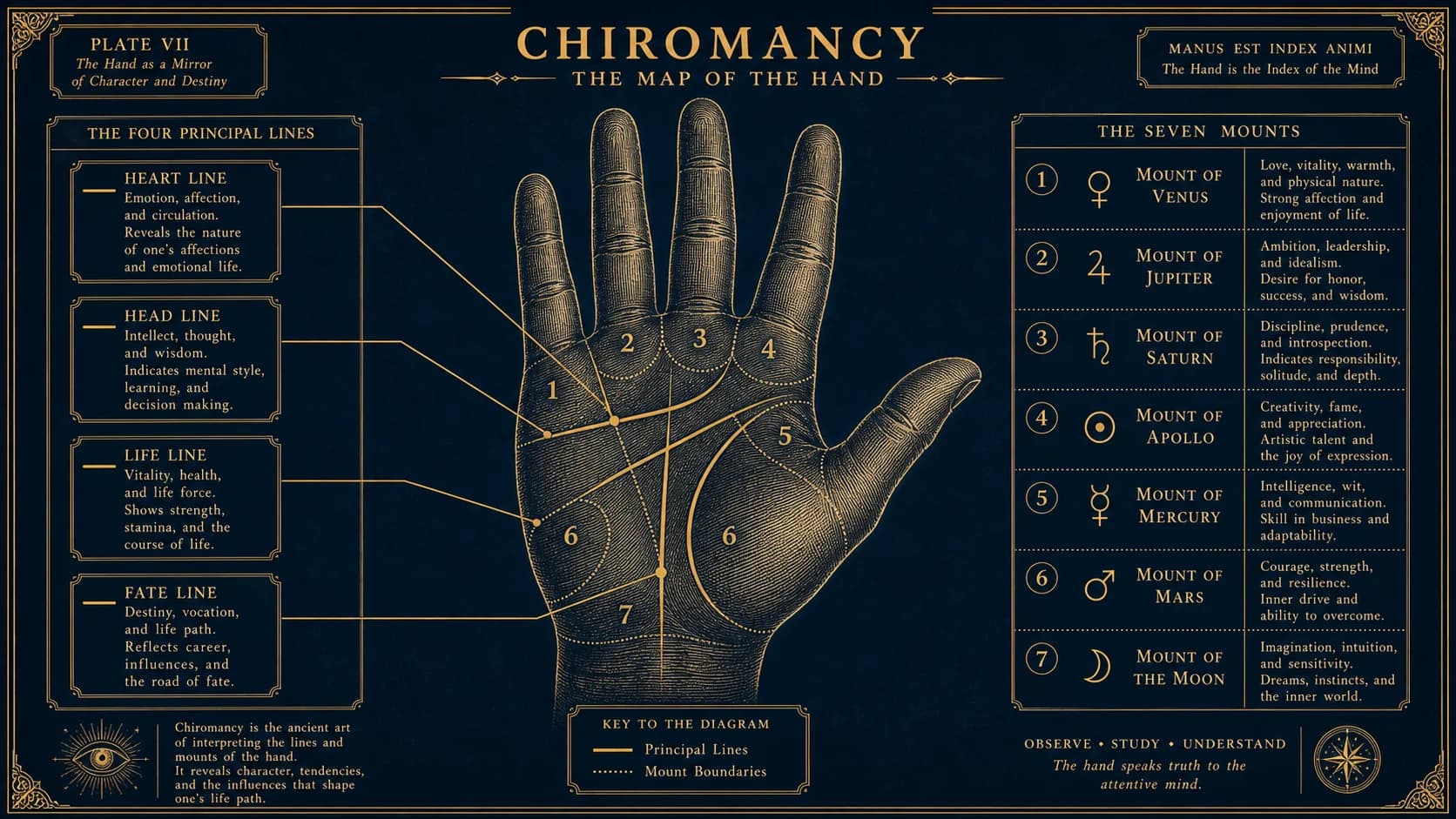
This guide will give you five things. The 4 main lines and what each one reveals. The 7 mounts that amplify or temper what the lines say. The shape of your hand, which colors everything else. The special markings (stars, crosses, triangles, islands) that add precious nuance. And finally, how to take a good photo of your palm so your first reading lands cleanly.
One clarification before we start. Palmistry doesn't say how many years you have left to live, doesn't predict who you will marry, and doesn't guarantee you wealth. It does something far more useful: it holds up a mirror. Your job is to observe.
In Western palmistry, you read the dominant hand first (the one you write with). It reflects who you have become, the path you actually took, your present.
The non-dominant hand shows your birth potential, your inherited predispositions, what your soul carried when it arrived.
The real power of the practice is to compare the two. The differences between your two hands are often the most revealing passages. If your dominant hand has a much deeper life line than your non-dominant one, it means you developed your vitality along your journey. If your heart line is very different from one hand to the other, it means you deeply reworked your relationship to love.
It curves around the Mount of Venus, at the base of the thumb, forming an arch. It's the first one you look at in palmistry.
What it reveals: your overall vitality, your underlying energy, the major turning points of your life (a career change, a defining move, a profound inner transformation). A wide, deep line indicates solid vitality. A thin, fragmented line suggests a greater sensitivity to burnout.
What it does NOT reveal, despite the popular belief: your longevity. A short line does not mean a premature death. The statistics show no correlation between line length and life expectancy. A short line simply indicates a concentrated energy density rather than a diffuse one.
It starts below the little finger and crosses the palm horizontally, sometimes all the way to the Mount of Jupiter (below the index finger).
What it reveals: your emotional life, the way you love, your relational expectations, your capacity to give and receive. A heart line that rises toward Jupiter speaks of romantic idealism and high relational aspirations. A straight, clean line suggests a more rational approach to love.
Branches going upward (toward the fingers) are positive: they indicate enriching relationships. Branches going downward suggest past disappointments or sorrows that shaped the way you love.
It crosses the center of the palm, horizontally. Often confused with the heart line, it stands apart because it sits lower.
What it reveals: your thinking style.
Length matters too: long line means depth of reflection, short line means pragmatism and quick decisions.
It rises vertically from the bottom of the wrist toward the middle finger. Note: not everyone has one, and that's perfectly normal.
What it reveals: your sense of vocation, your professional direction, your feeling of moving in the right direction. When it's strong and continuous, it's a sign of a professional life aligned with your deep nature. When it's fragmented, it usually means you've gone through several pivots.
No fate line means you build your path without a predefined frame, which can be great freedom or a real challenge depending on where you are. Many entrepreneurs don't have a classic fate line.
The mounts are the fleshy bumps of the palm. They amplify or temper what the lines say depending on whether they are developed (prominent), flat or hollow.
At the base of the thumb. It's the largest of the mounts.
Full and firm mount: human warmth, sensuality, capacity to love generously, physical vitality. Flat mount: more emotionally distant, sensuality less expressed. Excessively swollen mount: risk of consuming sensuality, possessiveness.
Below the index finger. This is the mount of leadership.
Developed mount: ambition, charisma, natural ability to lead. Entrepreneur, manager, political leader profile. Flat mount: modesty, preference for a supporting role.
Below the middle finger. Mount of discipline and depth.
Developed: seriousness, sense of responsibility, taste for productive solitude. Researcher, philosopher, professor profile. Flat: need for lightness, allergy to routine.
Below the ring finger. Mount of creativity and radiance.
Developed: artistic talent, natural charm, public success. Creative, communicator, performer profile. Flat: more intimate creativity, little need for outside recognition.
Below the little finger. Mount of communication and business sense.
Developed: eloquence, commercial sense, quick mind. Salesperson, negotiator, writer profile. Flat: preference for silence and solitary thought.
It exists in two parts. Active Mars (between the thumb and the index finger) speaks of physical courage and combativeness. Passive Mars (between the little finger and the edge of the palm) speaks of moral resistance, patience, the ability to endure.
On the edge opposite the thumb, toward the base of the palm. Mount of imagination, intuition and inner life.
Developed: overflowing imagination, strong intuition, rich dream life, possible pull toward the spiritual or mystical. Flat: feet on the ground, but sometimes a lack of creative inspiration.
The overall shape of your hand completes the picture and reveals your dominant temperament. Four main types, modeled on the elements.
Square palm, short fingers. Practical, grounded, reliable nature. You feel at home with the concrete, the manual, the building of things. Often not very demonstrative emotionally but loyally present.
Square palm, long fingers. Intellectual, communicative, mental nature. You live in ideas, you love conversations, you can spend hours analyzing. Tendency to overthink.
Long palm, short fingers. Energetic, intuitive, impulsive nature. You act before you analyze, you get excited fast, and you lose interest just as fast. Natural charisma.
Long palm, long fingers. Sensitive, artistic, deeply intuitive nature. You absorb atmospheres like a sponge. Often musical or literary talent.
Important note: the shape of your hand and your astrological sign are not necessarily aligned. Many Aries have an Earth hand, many Cancers an Air hand. The hand reflects your deep temperament, astrology reflects your natal chart. The two complement each other.
Beyond the main lines, certain small marks add precious nuance.
The Star is rare and powerful. It indicates a defining event, sudden, sometimes happy (on the Mount of Apollo, it's an artistic or public success), sometimes a shock (on the life line, it's a transformative rupture).
The Cross signals a point of crisis or decision. On the Mount of Jupiter (below the index finger), it's traditionally the sign of an important romantic encounter. On the head line, it's an intellectual dilemma or a mental pivot.
The Triangle is positive. It marks a specific talent or a domain where you can excel. Triangle on the life line means protected vitality. Triangle on the Mount of Apollo means real artistic talent.
The Square is the mark of protection. It indicates that you went through a trial linked to this zone and came out stronger. A square around a break in the life line means you overcame it.
The Island is a difficult period or a stretch of scattering along a line. Its end marks the return to flow.
The Grid (several crossed lines) on a mount indicates scattered energy in the domain of that mount. Grid on Mercury means muddled communication, grid on Venus means confused relationships.
A precise reading starts with a clear photo. Here are the rules to follow, whether you do the reading yourself or use our AI palmistry reading.
1. Natural light. Near a window, in daylight. Avoid flashes and direct overhead lighting, which create harsh shadows and mask the fine lines.
2. Dominant hand first. That's the one that speaks of your present. You can always do a second reading with your non-dominant hand afterward.
3. Palm fully open. Fingers relaxed, neither squeezed nor spread out like a fan. Keep a natural posture.
4. Centered in the frame. Your whole palm visible, from the wrist to the base of the fingers, with a bit of air around it.
5. Not too close, not too far. Close enough that the main lines show clearly, but not zoomed in so much that you lose the overall view.
6. Plain background. A light background (white sheet, plain wall) makes the lines stand out. Avoid reflective or textured surfaces.
7. Stability. If your hand shakes, the fine lines disappear. Rest your hand on a table or ask someone else to take the photo.
Classical palmistry requires an experienced practitioner several hours of observation and cross-reading between lines, mounts, marks and shapes. It's precious, but out of reach for most people.
That's exactly the role of our intelligence at luunar. Trained on the principles of traditional palmistry (Western and Indian), it analyzes in a few seconds the main lines, the shape of your hand, the seven mounts, and the special markings, then applies the classical interpretation rules to your case. What a practitioner does in several hours, you get in less than 30 seconds, free of subjective bias and with perfect coherence across every element.
Try a complete palm reading analysis by simply uploading a photo. It's the fastest way to go beyond the basics of this guide and get a complete personalized analysis.
Do the lines of the hand change over time?
Yes. The skin of the palm evolves slowly, and certain lines deepen, branch, even appear over the years. That's precisely why palmistry is seen as a reflection of the life you live, not a destiny carved in marble. Redo a reading every 2-3 years to observe what has shifted in you.
Does a short life line mean a premature death?
No. It's one of the most stubborn myths of popular palmistry. No statistical correlation exists between the length of the life line and actual lifespan. A short line simply indicates a concentrated energy density rather than a diffuse one. Many centenarians have a short life line.
Can you read a child's palm?
Technically yes, but with an important nuance. In a child, the lines are less formed and mainly reflect inherited potential. They will evolve a lot before adulthood. It's interesting for observing natural predispositions, but not useful for drawing precise predictions.
Is palmistry a reliable science?
Palmistry is a symbolic practice, not a science in the academic sense. It's precious as a tool for introspection because it invites you to ask questions about yourself starting from a tangible physical support. Users who approach it with openness often report surprising resonances with their real lives. Don't ask it to predict, ask it to mirror.
What's the difference between Western and Indian palmistry?
Western palmistry, heir to the Greek and Roman traditions, focuses on the main lines and the mounts. Indian palmistry (Samudrika Shastra) adds a karmic dimension and includes observations of the nails, the phalanges, and the color of the palm. The two schools agree on the essentials and complement each other on the nuances. Our AI draws mainly on the Western tradition, enriched with a few Indian contributions on hand shape.
Take the next step
Your hand holds your story
Read My Palm